 Design & Consultancy Services
Comprehensive Capabilities
Electrical Safety Audit
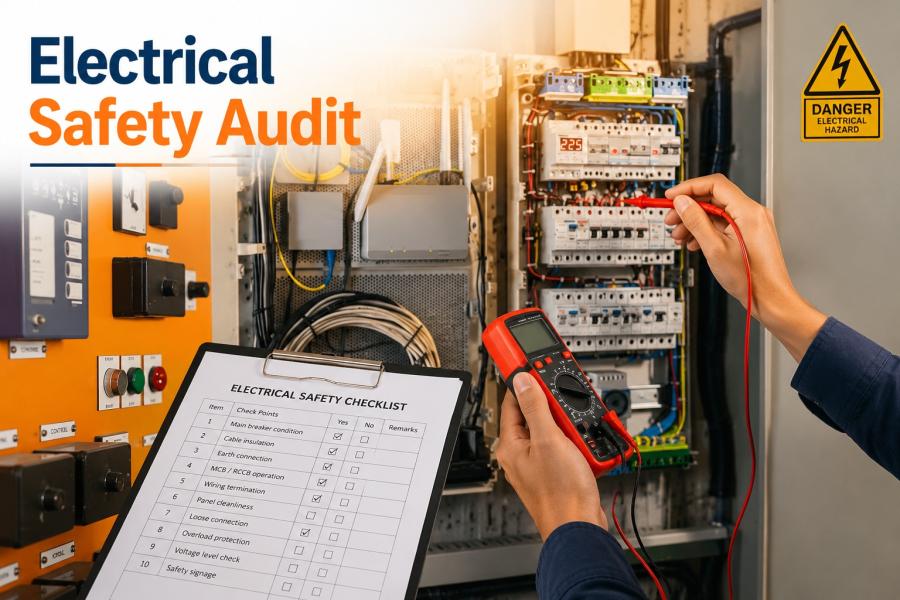
An Electrical Safety Audit is a systematic assessment of electrical installations, equipment, protection systems, earthling, wiring, maintenance practices, and related safety controls to identify hazards and compliance gaps.
Functions of an Electrical Safety Audit
Its main functions are to identify electrical hazards, evaluate protection and earthing, verify installation and maintenance conditions, assess risk, document deficiencies, and recommend practical corrective actions.
Importance & necessity of an Electrical Safety Audit
It helps organizations detect conditions such as overloading, poor earthing, damaged insulation, loose connections, inadequate protection, and unsafe working practices before they contribute to shock, fire, equipment failure, or operational disruption.
Core Process of an Electrical Safety Audit
The core process generally includes preliminary assessment, document review, physical inspection, electrical testing, risk evaluation, reporting, and corrective-action planning. The exact testing scope depends on the facility and safety conditions.
Design process for an Electrical Safety Audit
Audit planning involves defining the scope, identifying critical electrical systems, selecting inspection and testing methods, determining required instruments, establishing safety procedures, and developing risk-ranking and reporting criteria.
Applicable Sectors for an Electrical Safety Audit
Regulatory we follow for an Electrical Safety Audit
Depending on the project, the audit may consider the Electricity Rules, 2020, BNBC 2020, applicable Bangladesh labor laws and rules, and relevant IEC, NFPA, IEEE, or other recognized standards. The final compliance framework should be confirmed according to the facility and applicable authority requirements.
Learn More: Detailed Engineering Specifications & Media
Electrical Safety Audit: Engineering Overview & Scope
In Bangladesh's industrial and commercial sectors, electrical system failures, loose terminations, insulation breakdowns, and overcurrent surges represent over 75% of all factory fire origins. An Electrical Safety Audit is an exhaustive diagnostic engineering assessment that systematically inspects high-voltage (HT) substations, low-tension (LT) switchgear, Power Factor Improvement (PFI) plants, motor control centers (MCC), busbar trunking (BBT), and cable routing topologies.
Techno Apogee conducts certified electrical audits utilizing precision non-destructive testing (NDT) instruments—including thermal imaging cameras, earth resistance testers, power quality analyzers, and insulation resistance meters—to identify latent electrical hazards, protect physical assets, and achieve full statutory compliance with BNBC 2020, DIFE, RSC, and Nirapon mandates.
Our certified electrical engineering audit follows structured diagnostic protocols engineered to eliminate hazards and optimize reliability
· Certified Electrical Engineering Experts: Audits conducted by senior electrical engineers registered with professional engineering institutions and safety authorities.
· Calibrated NDT Instrumentation: Utilizing FLIR thermal imaging cameras, Megger insulation testers, Chauvin Arnoux earth testers, and Fluke power analyzers.
· Exhaustive Substation & Distribution Diagnostics: Full assessment of transformers, switchgear, circuit breakers, busbars, cable trays, and distribution boards.
· Direct Authority Compliance Clearance: Generating detailed Corrective Action Plans (CAP) tailored to satisfy DIFE, RSC, Nirapon, and international buyer audit teams.
Core Technical Functions & Diagnostic Testing ProceduresOur certified electrical engineering audit follows structured diagnostic protocols engineered to eliminate hazards and optimize reliability:
· 1. Calibrated Infrared Thermographic Scanning under Full Load: Scanning electrical switchboards, breaker terminations, busbar joints, and transformer terminals under peak production load to detect thermal hotspots, phase imbalances, and loose connections.
· 2. Single-Line Diagram (SLD) As-Built Verification & Cable Sizing: Verifying accuracy of existing Single-Line Diagrams (SLD), comparing breaker ratings against continuous cable ampacities, and identifying dangerous overcurrent hazards.
· 3. Earth Grounding Pit Resistance & Loop Impedance Testing: Measuring earth pit resistance values per BNBC Part 8 requirements (maximum 1 to 5 ohms) and checking equipotential bonding of all metal machinery enclosures.
· 4. Insulation Resistance (Megger) Testing on Main Feeders & Motors: Evaluating dielectric integrity of HT/LT power cables, busbars, and motor windings to identify micro-cracks, moisture ingress, and short-circuit risks before catastrophic arcing occurs.
· 5. Power Quality, Harmonic Distortion & PFI Diagnostics: Analyzing voltage sags, power factor efficiency, Total Harmonic Distortion (THD), and checking capacitance bank health to prevent capacitor explosion and energy waste.
· 6. Lightning Protection System (LPS) & Surge Arrester Auditing: Inspecting air terminals, down-conductors, test links, and Type 1/2 Surge Protection Devices (SPD) per BNBC and IEC 62305 standards.
Critical Necessity of Electrical Safety Audits
Regular third-party electrical audits provide indispensable business, safety, and legal safeguards:Personnel Arc Flash Protection: Ensuring proper breaker tripping coordination and earthing protects factory technicians against fatal electrocution.· Eliminating Electrical Fire Origin: Thermal scans detect glowing contact points and arcing before they ignite surrounding combustible materials.
· Machine Downtime & Equipment Protection: Identifying phase imbalance and harmonic overheating safeguards expensive motors, drives, and transformers.
· Energy Loss Reduction: Optimizing Power Factor Improvement (PFI) capacitors eliminates utility penalty charges and reduces energy bills.
· Statutory Safety Clearance: Immediate compliance with mandatory audit protocols mandated by DIFE, RSC, Nirapon, and trade licensing bodies.
Regular third-party electrical audits provide indispensable business, safety, and legal safeguards:
· Eliminating Electrical Fire Origin: Thermal scans detect glowing contact points and arcing before they ignite surrounding combustible materials.
· Machine Downtime & Equipment Protection: Identifying phase imbalance and harmonic overheating safeguards expensive motors, drives, and transformers.
· Energy Loss Reduction: Optimizing Power Factor Improvement (PFI) capacitors eliminates utility penalty charges and reduces energy bills.
· Statutory Safety Clearance: Immediate compliance with mandatory audit protocols mandated by DIFE, RSC, Nirapon, and trade licensing bodies.
· Personnel Arc Flash Protection: Ensuring proper breaker tripping coordination and earthing protects factory technicians against fatal electrocution.
5-Stage Engineering Audit Workflow
Our diagnostic audit lifecycle ensures thorough, transparent investigation and actionable solutions:· Stage 1 - Pre-Audit Document & SLD Review: Scrutinizing sanctioned electrical load approvals, previous audit findings, and substation single-line drawings.
· Stage 2 - Physical Walkthrough & Substation Inspection: Inspecting transformer oil levels, silica gel breathers, HT breaker vacuum bottles, and cable trench neatness.
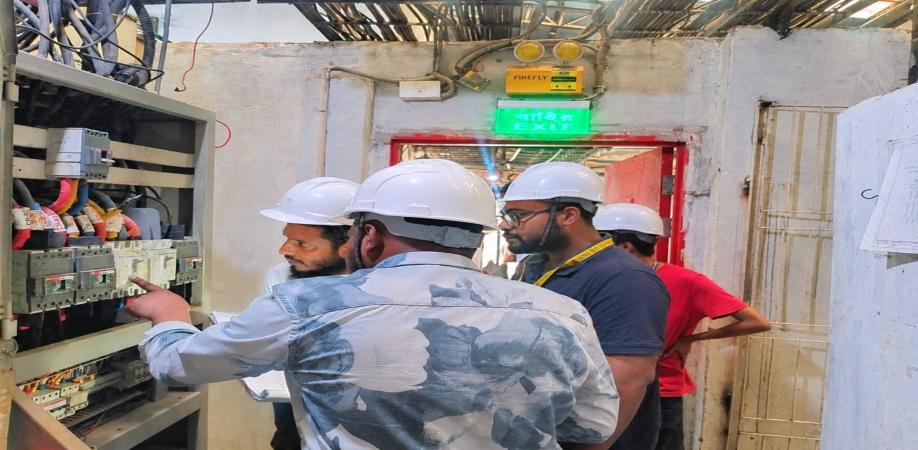
· Stage 3 - Live Field Diagnostic Testing & Thermography: Deploying calibrated thermal cameras, earth testers, and clamp meters across all operational electrical panels.
· Stage 4 - Gap Analysis & Engineering Calculations: Comparing field data against BNBC Part 8 and NFPA 70 thresholds to formulate a comprehensive risk severity matrix.
· Stage 5 - Engineering Audit Report & CAP Handover: Delivering an executive engineering report featuring thermal images, test value certificates, and prioritized CAP retrofitting recommendations.
High-Demand Industrial Sectors We Audit
We conduct specialized electrical audits across high-load and hazardous industrial environments:· Textile, Spinning & Garment Factories: High-power spinning frames, circular knitting, dyeing autoclaves, and large-scale sewing lines.
· Heavy Manufacturing & Steel Rolling Mills: Induction furnaces, heavy arc welders, rolling mills, and continuous casting plant substations.
· Tier 3/4 Data Centers & Telecom Hubs: Mission-critical server facilities requiring 99.999% uptime, UPS power redundancy, and clean grounding.
· Commercial Towers & Shopping Malls: High-density multi-tenant buildings, central chiller plants, and high-speed elevator bank distributions.
· Pharmaceutical & Chemical Formulations: Explosion-proof electrical equipment, flame-proof fixtures in solvent zones, and cleanroom air handling units.
Electrical Codes & Standards We Enforce
All audit inspections, thermal assessments, and calculations strictly conform to national building codes and international standards:IEC 60364 & IEC 62305: International Electrotechnical Commission criteria for low-voltage electrical installations and lightning risk management.· BNBC 2020 Part 8 (Building Services - Electrical & Mechanical Installations): Mandates for wiring systems, load calculations, lightning protection, and grounding safety.
· Electricity Act 2018 & Bangladesh Electricity Rules: National statutory mandates for electrical installation safety, licensing, and inspectorate guidelines.
· NFPA 70 (National Electrical Code - NEC): Worldwide benchmark for electrical wiring, conductor sizing, and overcurrent protection.
· NFPA 70E (Standard for Electrical Safety in the Workplace): Industry-standard protocols for arc flash boundary calculation, lockout/tagout (LOTO), and personal protective equipment (PPE).
· IEEE Standards for Power Systems: IEEE 141 (Red Book) for industrial power distribution, IEEE 142 (Green Book) for grounding, and IEEE 446 for emergency power systems.
Organizations That Implemented This Solution